
Centrifuge: How It Works, Types, Uses, and How to Choose One

A centrifuge is a laboratory and medical device used to separate components of a sample based on differences in density.
By rapidly rotating samples around a central axis, a centrifuge generates centrifugal acceleration that causes denser components to move away from the center while less-dense components remain closer to the center.
Centrifuges are used in many environments, including:
Medical laboratories
Veterinary clinics
Research laboratories
Diagnostic facilities
Hospitals
Healthcare practices
Educational laboratories
Different applications require different centrifuge configurations. A small clinic may need a compact benchtop centrifuge, while a high-volume laboratory may require a larger system with greater capacity and more advanced controls.
This guide explains how a centrifuge works, the main types of centrifuges, common applications, important specifications, and what to consider when choosing a centrifuge machine.
What Is a Centrifuge?
A centrifuge is a machine that uses high-speed rotation to separate substances within a sample.
When a sample is placed inside a centrifuge and rotated, particles with different densities respond differently to the generated force.
The process can separate components such as:
Cells
Blood components
Plasma
Serum
Sediment
Other suspended particles
The exact separation depends on the sample, rotor, speed, time, temperature, and other operating conditions.
How Does a Centrifuge Work?
The basic principle of centrifugation involves rapidly rotating a sample around a fixed axis.
As the rotor spins, the sample experiences acceleration directed outward from the axis of rotation.
Denser particles generally migrate toward the outer portion of the sample tube, while less-dense components remain closer to the center.
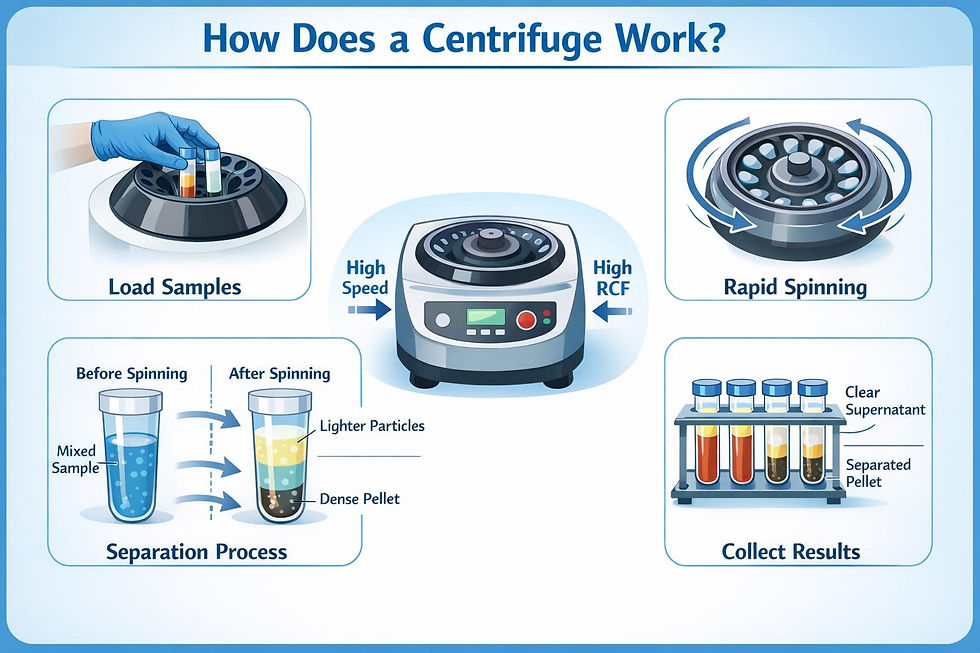
A typical centrifugation process involves:
1. Preparing the Sample
The sample is placed into an appropriate centrifuge tube or container.
2. Loading the Rotor
The tubes are positioned correctly inside the rotor.
3. Balancing the Rotor
Samples must be balanced according to the manufacturer's instructions.
4. Selecting the Settings
The operator selects the appropriate speed, time, and other available parameters.
5. Centrifugation
The rotor accelerates and spins the samples at the selected settings.
6. Separation
Components separate according to their physical properties.
7. Removing the Samples
After the rotor has stopped completely, the samples can be removed and processed further.
The correct procedure depends on the centrifuge model, sample type, and laboratory protocol.
What Is Centrifugation Used For?
Centrifugation is used whenever a sample needs to be separated into components based on differences in density or sedimentation behavior.
Common applications include:
Blood sample processing
Serum separation
Plasma preparation
Cell separation
Laboratory sample preparation
Research
Veterinary diagnostics
Clinical testing
Chemical analysis
The exact application depends on the centrifuge and the sample being processed.
Blood Centrifuge Applications
A blood centrifuge is commonly used to separate components of blood samples.

Depending on the sample and protocol, centrifugation can help separate components such as:
Plasma
Serum
Blood cells
For example, after appropriate processing, a blood sample may separate into visible layers with different densities.
The exact procedure, tube type, centrifugation conditions, and subsequent testing depend on the laboratory's validated protocol.
Centrifuges in Veterinary Clinics
Centrifuges can also be useful in veterinary diagnostic workflows.
Veterinary practices may process samples such as:
Blood
Serum
Plasma
Urine
Other laboratory specimens
A centrifuge can allow compatible samples to be prepared for further examination or testing.
When selecting a centrifuge for veterinary use, consider:
Sample types
Tube sizes
Number of samples
Required speed
Rotor configuration
Available space
Frequency of use
Types of Centrifuges
Centrifuges come in a variety of designs.
The appropriate type depends on the application, sample volume, required speed, and available laboratory space.
Benchtop Centrifuges
Benchtop centrifuges are designed to sit on a laboratory or clinical work surface.
They are useful when:
Space is limited
Moderate sample volumes are processed
A compact footprint is preferred
The centrifuge needs to be located near other laboratory equipment
Benchtop systems are available in different speeds, capacities, and rotor configurations.
Fixed-Speed Centrifuges
A fixed-speed centrifuge operates at a predetermined or limited speed.
These systems can be useful for applications where a consistent operating speed is sufficient.
Advantages can include:
Simple operation
Consistent settings
Straightforward workflow
Lower operational complexity
The appropriate speed depends on the intended application.
Variable-Speed Centrifuges
Variable-speed centrifuges allow the operator to select different rotational speeds.
This flexibility can be useful when a laboratory processes different sample types or requires different separation conditions.
When comparing a variable-speed centrifuge machine, check the available speed range and whether the system provides the control features required for your applications.
Portable Centrifuges
Portable or compact centrifuges can be useful when mobility and limited workspace are important.
They may be suitable for certain point-of-care, field, veterinary, or small laboratory applications.
However, portability should not be considered independently from:
Capacity
Speed
Rotor type
Power requirements
Safety features
Intended sample types
Digital Centrifuges
Digital centrifuges typically provide electronic controls for parameters such as speed and time.
Depending on the model, digital systems may offer:
Digital displays
Programmable settings
Timer controls
Speed adjustment
Error notifications
Safety monitoring
The available features vary by manufacturer and model.
Centrifuge Rotor Types
The rotor is one of the most important components of a centrifuge.
Different rotor designs are suited to different applications.
Fixed-Angle Rotors
The tubes are held at a fixed angle while the rotor spins.
These rotors are commonly used for applications requiring efficient sedimentation of particles.
Swing-Out Rotors
The tubes swing outward as the rotor accelerates.
This configuration can be useful for applications where a more horizontal separation profile is desirable.
The appropriate rotor depends on the sample and centrifugation protocol.
Centrifuge Tubes
Centrifuge tubes are designed to hold samples during centrifugation.

Centrifuge tubes are available in different:
Sizes
Materials
Capacities
Shapes
Closure designs
Not every tube is compatible with every centrifuge.
Before using a tube, verify that it is rated for the required centrifugal force and compatible with the rotor and sample.
RPM vs. RCF: What's the Difference?
One of the most important concepts when selecting centrifugation settings is the difference between RPM and RCF.
RPM
RPM means revolutions per minute.
It describes how quickly the centrifuge rotor is rotating.
RCF
RCF means relative centrifugal force.
It describes the acceleration experienced by the sample relative to Earth's gravitational acceleration.
Two centrifuges operating at the same RPM can produce different RCF values if their rotor radii differ.
For this reason, laboratory protocols may specify RCF rather than RPM.
When following a procedure, always use the units specified by the validated protocol and equipment manufacturer.
Why Rotor Radius Matters
Rotor radius affects the centrifugal force generated at a particular RPM.
This means that two centrifuges running at the same rotational speed can produce different separation conditions.
When comparing centrifuges, consider:
Maximum RPM
Maximum RCF
Rotor radius
Rotor type
Tube capacity
Maximum RPM alone does not tell you everything about a centrifuge's performance.
Centrifuge Capacity
Capacity refers to how many samples the centrifuge can process at one time.
For example, a centrifuge might accommodate:
A small number of tubes
Multiple small tubes
Larger sample containers
Different rotor configurations
Higher capacity can improve efficiency in busy environments, but a larger centrifuge may require more space.
Choose capacity based on your typical workload.
What Is the Right Centrifuge Speed?
There is no universal centrifuge speed.
The correct speed depends on:
Sample type
Tube type
Rotor
Required separation
Protocol
Centrifugation time
RCF requirements
Using an inappropriate speed can affect sample quality or produce an unwanted separation.
Always follow the applicable laboratory procedure and manufacturer's instructions.
Centrifuge Safety
Centrifuges operate at high rotational speeds, so proper safety procedures are essential.
Important precautions include:
Always balance samples correctly.
Use compatible tubes and rotors.
Never exceed the rotor's rated speed.
Inspect tubes before use.
Make sure the lid is securely closed.
Never open the centrifuge while the rotor is moving.
Wait until the rotor has completely stopped.
Follow manufacturer instructions.
Perform required maintenance and inspections.
A centrifuge should never be operated with damaged tubes, rotors, or other components.
Why Is Balancing a Centrifuge Important?
Balancing is one of the most important centrifuge operating procedures.
Samples should generally be arranged so that the load is balanced according to the manufacturer's instructions.
An unbalanced rotor can cause:
Excessive vibration
Noise
Reduced equipment performance
Sample disturbance
Equipment damage
Safety hazards
Some centrifuges have imbalance detection systems, but operators should still load the rotor correctly.
How to Balance Centrifuge Tubes
When balancing samples:
Use compatible tubes.
Match tube types and sizes where required.
Balance opposing positions according to the rotor design.
Ensure sample masses are appropriately matched.
Follow the centrifuge manufacturer's loading instructions.
Do not assume that two tubes have the same mass simply because they have the same volume.
The exact balancing procedure depends on the rotor.
Centrifuge Maintenance
Regular maintenance helps support reliable operation.
Maintenance requirements vary between models but can include:
Rotor inspection
Cleaning
Tube-holder inspection
Lid and lock inspection
Checking seals
Removing spills
Inspecting cables
Preventive servicing
Calibration or verification when required
Always follow the manufacturer's maintenance instructions.
How to Clean a Centrifuge
Cleaning procedures should follow the manufacturer's recommendations.
In general, operators should:
Stop the centrifuge completely.
Disconnect power when required.
Remove the rotor or accessories according to the instructions.
Clean spills promptly.
Use compatible cleaning agents.
Dry components appropriately.
Inspect for corrosion or damage.
Harsh chemicals may damage certain centrifuge components.
Always confirm chemical compatibility before cleaning.
How to Choose the Right Centrifuge Machine
Choosing a centrifuge machine starts with understanding your application.
1. Identify Your Samples
What types of samples will you process?
For example:
Blood
Serum
Plasma
Urine
Research samples
Veterinary specimens
2. Determine Required Capacity
How many samples do you process during a typical run?
3. Determine Required RCF
Look at your protocols to determine the required centrifugal force.
4. Consider Rotor Type
Determine whether a fixed-angle or swing-out rotor is more appropriate.
5. Consider Tube Compatibility
Make sure your tubes are compatible with the rotor and centrifuge.
6. Consider Available Space
Measure the available workspace.
7. Consider Controls
Determine whether you need:
Fixed speed
Variable speed
Digital controls
Programmable cycles
Timer functions
8. Consider Safety Features
Look for features such as:
Lid locking
Imbalance detection
Overspeed protection
Automatic stopping
Error notifications
9. Consider Service and Support
Technical support and replacement components can be important over the equipment's lifespan.
Important Centrifuge Specifications to Compare
Specification | Why It Matters |
Maximum RPM | Indicates maximum rotor speed |
Maximum RCF | Indicates maximum centrifugal force |
Capacity | Determines samples per run |
Rotor type | Affects sample positioning and separation |
Tube compatibility | Ensures appropriate sample containers |
Timer | Controls run duration |
Speed control | Determines flexibility |
Imbalance detection | Adds an important safety function |
Lid lock | Helps prevent opening during operation |
Footprint | Important for workspace planning |
Noise level | Can matter in clinical environments |
Service support | Important for long-term operation |
Common Centrifuge Mistakes
Choosing Based Only on RPM
A higher RPM doesn't automatically mean a better centrifuge.
RCF, rotor radius, rotor type, and application requirements also matter.
Ignoring Rotor Compatibility
A centrifuge and tube system must be compatible.
Always check the manufacturer's specifications.
Buying Too Much Capacity
A large centrifuge may take up unnecessary space if your sample volume is low.
Buying Too Little Capacity
A small centrifuge can become inefficient if the clinic or laboratory regularly processes many samples.
Ignoring Sample Requirements
Different samples may require different centrifugation conditions.
Forgetting Service Requirements
Maintenance and technical support should be considered before purchasing.
Centrifuge Buying Checklist
Before purchasing a centrifuge, ask:
☐ What samples will we process?
☐ How many samples do we process per run?
☐ What RCF is required?
☐ What RPM range is needed?
☐ Which rotor type is appropriate?
☐ What centrifuge tubes will we use?
☐ Is the capacity sufficient?
☐ Do we need variable-speed control?
☐ Do we need digital controls?
☐ What safety features are included?
☐ Does the machine fit our workspace?
☐ What maintenance is required?
☐ Is technical support available?
☐ What warranty is included?
Centrifuges for Medical Laboratories
Medical laboratories can use centrifuges as part of sample preparation workflows.
Depending on the application, centrifugation may be used before laboratory testing to separate components of blood or other specimens.

The appropriate centrifuge depends on:
Sample volume
Number of samples
Required RCF
Tube types
Rotor configuration
Laboratory workflow
Centrifuges for Veterinary Applications
Veterinary clinics and laboratories may use centrifuges for diagnostic sample preparation.
A veterinary practice should consider the types and volumes of samples it processes when selecting equipment.
For smaller practices, a compact centrifuge may be sufficient.
A larger veterinary facility with higher sample volumes may benefit from greater capacity and more flexible rotor configurations.
How Much Does a Centrifuge Cost?
Centrifuge pricing varies depending on the machine's specifications and intended application.
Factors affecting cost can include:
Capacity
Maximum speed
Maximum RCF
Rotor type
Digital controls
Programmability
Safety features
Construction
Accessories
Warranty
Technical support
Rather than choosing solely based on purchase price, compare the complete equipment configuration against your actual laboratory requirements.
Frequently Asked Questions About Centrifuges
What is a centrifuge used for?
A centrifuge is used to separate components of a sample based on differences in density and sedimentation behavior.
How does a centrifuge work?
A centrifuge rapidly rotates samples around a central axis, generating centrifugal acceleration that causes components with different densities to separate.
What is a centrifuge machine?
A centrifuge machine is equipment designed to perform controlled centrifugation of laboratory, medical, veterinary, or research samples.
What is a blood centrifuge?
A blood centrifuge is a centrifuge used to process blood samples and separate components such as serum, plasma, and blood cells according to the applicable protocol.
What are centrifuge tubes?
Centrifuge tubes are sample containers designed to withstand the centrifugal forces generated during centrifugation.
What is RPM?
RPM stands for revolutions per minute and describes how quickly the centrifuge rotor rotates.
What is RCF?
RCF stands for relative centrifugal force and describes the acceleration applied to the sample relative to Earth's gravitational acceleration.
Is a higher RPM always better?
No. The appropriate speed depends on the sample, rotor, protocol, and required RCF. A higher RPM is not necessarily better for every application.
Why does a centrifuge need to be balanced?
Proper balancing reduces vibration and helps prevent equipment damage and unsafe operating conditions.
Can centrifuges be used in veterinary clinics?
Yes. Centrifuges can be used in veterinary diagnostic workflows to process compatible blood and other laboratory samples.
Choosing the Right Centrifuge
The right centrifuge depends on the application, not simply the maximum speed or capacity.
Before purchasing, identify the types of samples you will process, the required RCF, the number of samples per run, the appropriate rotor, and the centrifuge tubes you plan to use.
For medical, veterinary, and laboratory environments, a properly matched centrifuge can support efficient sample preparation and consistent workflows.
Whether you need a compact system for a small practice or a higher-capacity system for a busy laboratory, evaluating the complete configuration will help you select a centrifuge machine that fits your needs.


Comments